
Not all spines are created the same…

Scoliosis is the sideways curvature of the spine, in either an “S” or “C” shape. This orthopedic condition affects people of all ages, from kids to adults.
Defining Scoliosis
At its core, scoliosis is a medical condition characterized by an abnormal lateral curvature of the spine. Instead of the spine maintaining a straight, vertical alignment, it adopts a sideways curve, resembling either a C or an S shape. This curvature can occur at any point along the spine, from the upper (thoracic) to the lower (lumbar) regions.

Image Source: scoliosissos.com
C-curve scoliosis is characterized by a curvature bending in one direction, forming a C-shaped spinal curve. This form of scoliosis can present in various manifestations:
- Lumbar Curve: This curvature is observed in the lower (lumbar) back.
- Thoracolumbar Curve: Initiated in the upper back and concluding in the lower back, this type of C curve manifests along the thoracolumbar region.
- Thoracic Curve: This C-curve scoliosis bend is located in the upper (thoracic) back.
S-curve scoliosis is characterized by the presence of two curves in the spine, one in the upper back and another in the lower back. When these curves diverge in opposite directions, the spine takes on an appearance reminiscent of the letter ‘S.’
While less common than C-curve scoliosis, S-curve scoliosis does not necessarily result in more severe symptoms. This type of scoliosis, also referred to as a double major curve, involves both a thoracic (upper back) curve and a lumbar (lower back) curve. Due to the potential balancing effect of these curves, detecting S-curve scoliosis can be challenging initially.
Degrees of Scoliosis
Scoliosis is measured in degrees to quantify the severity of the curvature in the spine. The degree of curvature is typically assessed through a standing X-ray image, allowing healthcare professionals to determine the angle of deviation from the normal alignment of the spine. The measurement is known as the Cobb angle, named after orthopedic surgeon John R. Cobb, who developed this method.
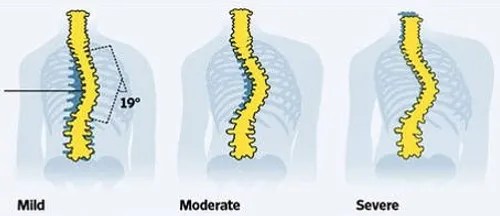
Image Source: islipchiropractic.com
Here are the general classifications based on the Cobb angle:
- Mild Scoliosis:
- Cobb Angle: 10 to 25 degrees
- Moderate Scoliosis:
- Cobb Angle: 25 to 40 degrees
- Severe Scoliosis:
- Cobb Angle: 40 degrees and above
Types of Scoliosis
Scoliosis is a complex condition, and it manifests in various types based on factors such as age of onset, cause, and the location of the spinal curvature. Here are some common types of scoliosis:
- Idiopathic Scoliosis:
- This is the most prevalent form, constituting approximately 80% of all scoliosis cases. Idiopathic scoliosis has no identifiable cause, and it typically emerges during adolescence.
- Congenital Scoliosis:
- Congenital scoliosis is present at birth and results from abnormalities in the formation of the spine during fetal development. It occurs when vertebrae do not form properly.
- Neuromuscular Scoliosis:
- This type is associated with neurological or muscular conditions, such as cerebral palsy or muscular dystrophy. Neuromuscular scoliosis is a result of muscle imbalance or weakness.
- Degenerative Scoliosis:
- Degenerative scoliosis develops in adulthood due to the natural aging process, where the spine undergoes degenerative changes such as disc degeneration and arthritis.
- Adolescent Idiopathic Scoliosis (AIS):
- AIS is the most common type of scoliosis in adolescents and typically emerges during puberty. It has no known cause and often occurs in otherwise healthy individuals.
- Juvenile Idiopathic Scoliosis (JIS):
- JIS develops in children between the ages of 3 and 10. Similar to AIS, the cause is unknown, and it requires close monitoring and potential intervention.
- Infantile Idiopathic Scoliosis:
- This rare form of scoliosis occurs in infants, usually before the age of 3. While it may resolve on its own, close monitoring is essential.
- Adult Idiopathic Scoliosis:
- Adult idiopathic scoliosis develops after skeletal maturity and may be a continuation of a curvature that began in adolescence. It can also manifest in adulthood without prior history.
- Functional Scoliosis:
- Functional scoliosis results from a secondary cause, such as muscle imbalance or leg length discrepancy. Unlike structural scoliosis, the spine is structurally normal, and the curvature is correctable.
- Nonstructural Scoliosis (Postural Scoliosis):
- Similar to functional scoliosis, nonstructural scoliosis is reversible and results from factors like muscle spasms or poor posture.
- Secondary Scoliosis:
- Secondary scoliosis is a result of another underlying condition or surgery, such as spinal surgery or tumors affecting the spine.
Causes
Scoliosis can have various causes, and in many cases, the exact origin remains unknown. The following are some common causes and categories of scoliosis:
- Idiopathic Scoliosis:
- Idiopathic scoliosis is the most prevalent form, and its cause is not clearly understood. It typically develops during adolescence, and while genetic factors are thought to play a role, the precise cause remains elusive.
- Congenital Scoliosis:
- Congenital scoliosis is present at birth and results from abnormalities in the formation of the spine during fetal development. It occurs when the vertebrae do not form properly.
- Neuromuscular Conditions:
- Certain neuromuscular conditions, such as cerebral palsy, muscular dystrophy, or spinal cord abnormalities, can lead to scoliosis. The imbalance in muscle strength or tone contributes to the development of an abnormal spinal curvature.
- Degenerative Changes:
- Degenerative scoliosis occurs in adulthood and is associated with the natural aging process. Degenerative changes in the spine, such as disc degeneration and arthritis, can lead to the development of scoliosis.
- Connective Tissue Disorders:
- Some connective tissue disorders, such as Marfan syndrome or Ehlers-Danlos syndrome, may contribute to the development of scoliosis. These conditions affect the connective tissues that provide support to the spine.
- Genetic Factors:
- While the specific genetic factors contributing to idiopathic scoliosis are not fully understood, there is evidence suggesting a genetic predisposition. If a family member has scoliosis, there may be an increased risk for others in the family.
- Leg Length Discrepancy:
- A significant difference in leg length can result in scoliosis. The body may attempt to compensate for the imbalance by developing a curvature in the spine.
- Injuries or Infections:
- Trauma, injuries, or infections affecting the spine can sometimes lead to scoliosis. While less common, these factors can contribute to the development of an abnormal curvature.
- Neurofibromatosis:
- Neurofibromatosis is a genetic disorder that can cause tumors to grow on nerves. In some cases, scoliosis may be associated with neurofibromatosis.
- Pregnancy-Related Scoliosis:
- Changes in the body during pregnancy, such as hormonal fluctuations and postural adjustments, can contribute to temporary scoliosis.
Symptoms
Scoliosis is a condition characterized by an abnormal curvature of the spine, and its symptoms can vary depending on the severity of the curvature and other factors. Here are common signs and symptoms associated with scoliosis:
- Uneven Shoulders:
One shoulder may appear higher than the other when observed from the front or back. - Asymmetry in the Waist or Hips:
The waistline or hips may appear uneven, with one side higher than the other. - Uneven Leg Length:
In some cases, scoliosis can cause a noticeable difference in leg length, leading to an uneven stance. - Prominent Shoulder Blade:
The prominence or protrusion of one shoulder blade may be more noticeable than the other. - Tilted Head:
The head may tilt to one side, and the alignment of the ears may not be level. - Visible Curve in the Spine:
When bending forward, a visible curve in the spine may be evident, indicating the presence of scoliosis. - Back Pain:
Some individuals with scoliosis may experience back pain, particularly if the curvature puts pressure on nerves or causes muscle imbalances. - Changes in Gait or Posture:
Scoliosis can impact the overall posture and walking pattern. Individuals may develop a noticeable shift in their gait. - Clothing Fit Changes:
Clothes may not hang symmetrically on the body, and individuals may notice changes in the way clothes fit. - Limited Range of Motion:
Severe scoliosis can restrict the range of motion in the spine, making certain movements challenging. - Breathing Difficulties (in severe cases):
In some instances, particularly when scoliosis affects the thoracic (upper) spine, breathing difficulties may occur as the curvature puts pressure on the lungs. - Fatigue:
Scoliosis can lead to muscle imbalances and fatigue, especially in the muscles that are compensating for the spinal curvature.
Prevention
Preventing scoliosis is challenging because the exact cause of most cases, particularly idiopathic scoliosis, is often unknown. However, there are some general strategies and practices that may contribute to overall spine health and potentially reduce the risk of developing scoliosis or other spinal issues:
- Regular Physical Activity:
Engaging in regular exercise, including activities that promote core strength, flexibility, and good posture, can contribute to overall spine health. Strengthening the muscles around the spine may provide support and stability. - Maintain a Healthy Weight:
Maintaining a healthy weight reduces the stress on the spine and helps prevent the development of musculoskeletal issues. - Practice Good Posture:
Encourage good posture, both while sitting and standing. Proper spinal alignment can reduce the risk of developing spinal abnormalities. - Ergonomic Workspace:
Ensure that workstations and study areas are ergonomically designed to promote good posture. This includes having a supportive chair, an ergonomic desk, and maintaining eye level with the computer screen. - Regular Health Check-ups:
Regular health check-ups, especially during childhood and adolescence, can aid in the early detection of scoliosis. Early intervention is often more effective in managing the condition. - Avoid Heavy Backpacks:
For students, avoid carrying excessively heavy backpacks, as they can strain the back. Use backpacks with wide, padded shoulder straps and distribute the weight evenly. - Stay Informed:
Be aware of the signs and symptoms of scoliosis. Regularly check for any asymmetry in the shoulders, hips, or waist, and seek medical attention if abnormalities are observed. - Genetic Counseling:
If there is a family history of scoliosis, consider genetic counseling. While genetic factors are not fully understood, there may be a genetic predisposition in some cases. - Bone Health:
Ensure adequate intake of calcium and vitamin D for strong bone health. This is important for overall musculoskeletal well-being. - Avoid Smoking:
Smoking has been linked to a higher risk of developing spine-related issues. Quitting smoking can contribute to overall health, including the health of the spine.
 Alternative Scoliosis Treatments