
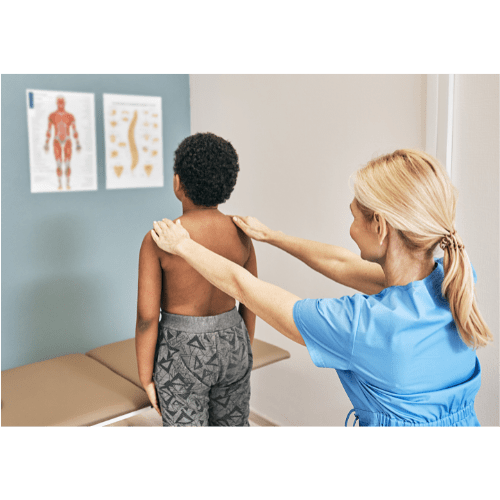
Scoliosis, a condition characterized by the abnormal lateral curvature of the spine, affects millions of people worldwide, with a significant portion being children and adolescents. Traditional treatment approaches have included bracing and, in severe cases, spinal fusion surgery. However, emerging research into vertebral body tethering (VBT) offers a promising alternative, especially for the pediatric population. In this comprehensive exploration, we delve into the exciting developments surrounding VBT as a potential game-changer in the management of children’s scoliosis.
Understanding Vertebral Body Tethering:
Vertebral body tethering is a surgical procedure designed to correct spinal curvature by guiding the growth of the spine in a more controlled manner. Unlike traditional spinal fusion, where vertebrae are fused together, VBT preserves the mobility of the spine while addressing the curvature.
The Procedure:
During VBT, a flexible cord or tether is secured to the affected vertebrae using screws. This tether restricts the growth on one side of the spine while allowing controlled growth on the other. The aim is to gradually correct the curvature as the child grows, providing a more natural and dynamic solution compared to fusion.
Key Advantages for Children:
- Preservation of Spinal Motion:
- Unlike spinal fusion, VBT allows for continued mobility and growth of the spine. This is particularly crucial for children as it enables normal spinal development.
- Reduced Impact on Daily Life:
- VBT typically involves a less invasive procedure compared to traditional spinal fusion. This can result in a shorter recovery time, less postoperative pain, and a quicker return to daily activities.
- Minimized Impact on Thoracic Development:
- The dynamic nature of VBT means that it has the potential to minimize the impact on thoracic development, an essential consideration for growing children.
- Adjustability and Flexibility:
- The tether used in VBT is adjustable, allowing for modifications as the child grows. This adaptability is a significant advantage over traditional surgical methods.
- Potential for Future Adjustments:
- If necessary, the tether can be removed or adjusted in the future, providing flexibility for ongoing management.
Recent Research Findings:
- Reduced Curve Progression:
- Studies have shown that VBT can effectively reduce the progression of spinal curvature in children and adolescents. This is particularly promising for those with moderate scoliotic curves.
- Improved Quality of Life:
- Research indicates that children who undergo VBT may experience an improved quality of life compared to those undergoing traditional spinal fusion surgery.
- Satisfactory Clinical Outcomes:
- Initial clinical outcomes of VBT have been encouraging, with many patients experiencing successful correction of their spinal curvature.
- Fewer Complications:
- Early evidence suggests that VBT may be associated with fewer complications compared to spinal fusion surgery, making it a safer option for children.
Existing Research:
- “Anterior vertebral body tethering for immature adolescent idiopathic scoliosis: One-year results on the first 32 patients.”
- Authors: Amer F Samdani 1, Robert J Ames, Jeff S Kimball, Joshua M Pahys, Harsh Grewal, Glenn J Pelletier, Randal R Betz
- Link: Read the article
- Conclusions: Our early results indicate that anterior VBT is a safe and potentially effective treatment option for skeletally immature patients with idiopathic scoliosis. These patients experienced an improvement of their scoliosis with minimal major complications. However, longer term follow-up of this cohort will reveal the true benefits of this promising technique.
- “Early outcomes in hybrid fixation for idiopathic scoliosis: posterior fusion combined with anterior vertebral body tethering. Patient series.”
- Authors: Sumeet Garg, Emily Arnold, et al.
- Link: Read the article
- Conclusions: From our experience with AVBT, we have learned that for most patients with thoracic-only curves, fusion is a better option. Similarly, the preservation of lumbar motion likely has not only benefits with respect to activity but also less degeneration later in life. The combined hybrid procedure—thoracic fusion and lumbar VBT—combines the best of both procedures. With respect to the fusion, it is imperative to impart as much kyphosis as possible to allow the lumbar spine to maximally correct. When performing the lumbar VBT, one must not overtension the proximal or distal ends, because this may induce overcorrection. In conclusion, the hybrid surgical treatment of idiopathic scoliosis in children is a novel combined technique of PSF in the thoracic spine and AVBT in the lumbar spine. It allows fixed correction of thoracic deformity while preserving motion in the lumbar spine. The initial experience was safe and well tolerated, but further longitudinal studies are warranted to assess the long-term effects of this treatment paradigm.
- “Patient-Reported Outcomes Are Equivalent in Patients Who Receive Vertebral Body Tethering Versus Posterior Spinal Fusion in Adolescent Idiopathic Scoliosis.”
- Authors: Catherine Qiu, Divya Talwar, James Gordon, Anthony Capraro, Carina Lott, Patrick J Cahill
- Link: Read the article
- “Anterior Vertebral Body Tethering for Idiopathic Scoliosis: Two-year Results.”
- Authors: Amer F Samdani 1, Robert J Ames, Jeff S Kimball, Joshua M Pahys, Harsh Grewal, Glenn J Pelletier, Randal R Betz
- Link: Read the article
- Conclusions: Anterior VBT is a promising technique for skeletally immature patients with idiopathic scoliosis. This technique can be performed safely and can result in progressive correction.
- “Vertebral Body Tethering: Rationale, Results, and Revision.”
- Authors: Baron Lonner, David A Weiner, Firoz Miyanji, Daniel G Hoernschemeyer, Lily Eaker, Amer F Samdani
- Link: Read the article
Challenges and Considerations:
While the early findings of VBT are promising, it’s important to acknowledge that more extensive research is needed to establish its long-term efficacy, safety, and broader applicability. Additionally, the accessibility of VBT and its cost-effectiveness compared to traditional treatments remain important considerations.
The exploration of vertebral body tethering represents a significant stride in scoliosis treatment, especially for the pediatric population. While further research is needed to establish its long-term efficacy and safety, the early findings are promising. Vertebral body tethering has the potential to revolutionize the approach to children’s scoliosis by providing a more flexible and dynamic solution that supports the natural growth and development of the spine. As ongoing research continues to unravel the full scope of VBT’s benefits, it stands as a beacon of hope for children and families navigating the complexities of scoliosis. The future holds the promise of a more patient-centric, less invasive, and dynamically adaptive solution for pediatric scoliosis, ultimately changing the landscape of treatment options for the better.
 Alternative Scoliosis Treatments
Leave a comment